
Incoterms® are widely used. So why do the same mistakes persist?
- Wednesday, August 12, 2026
- 4.5 minute read

You agree FCA with a customer.
Sales records the Incoterms® rule. Logistics arranges the shipment. Someone prepares the transport documents. Customs handles the export formalities. Finance needs the right evidence.
On paper, everyone may know what FCA means.
But does everyone involved understand what they are expected to do?
Research published in June 2026 by evofenedex found that Incoterms® 2020 are widely used by Dutch companies, but are not always applied correctly in practice. evofenedex is a Dutch business association for trade and logistics, representing more than 10,000 members.
Respondents reported discussions around costs, the transfer of risk and the responsibilities of buyers and sellers.
It points to a broader challenge in international trade: knowing the Incoterms® rule is not the same as applying it consistently.
Where Incoterms® knowledge can break down
One particularly interesting finding concerns knowledge. Respondents generally rated their own Incoterms® knowledge more highly than that of their colleagues, customers and suppliers. evofenedex identifies these differences in knowledge as an important cause of errors, disagreements and deviations from what was originally agreed.
The research gives practical examples. A business might agree FCA (Free Carrier), while the seller still prepares the CMR consignment note. Or it might agree EXW (Ex Works) with a buyer outside the EU, only for the seller to become involved in the export declaration.
These examples expose the real issue. The Incoterms® rule written into the agreement is only one part of the picture. What matters next is whether the people executing the transaction understand the responsibilities that follow from it.
When they do not, the difference may remain hidden until there is a delay, damage, customs control or disagreement over costs.
Incoterms® are not only a logistics decision
Incoterms® define responsibilities between buyer and seller concerning areas such as transportation costs, risk transfer and documentation. But they do not override public-law obligations such as sanctions or VAT requirements.
That distinction matters because an Incoterms® choice made during a commercial negotiation can have practical implications for people working in Sales, Logistics, Finance and Customs. The decision therefore should not sit with one department in isolation.
evofenedex reaches a similar conclusion. It recommends involving relevant departments, including sales, back office, logistics and finance, when developing an Incoterms® policy. Its research found that these departments can still operate separately, creating room for miscommunication.
From a customs perspective, the connections go further. Incoterms are one of the data elements Gaston Schul can review against commercial paperwork during Auditing, alongside representation, classification, customs procedure codes, origin, preference and valuation. Incoterms® can also form part of the wider picture when reviewing the VAT setup for a cross-border trade flow.
The lesson is not that Incoterms® determine every customs or tax obligation. They do not. It is that the commercial agreement needs to make sense alongside what actually happens to the goods.
EXW shows what can happen when the two diverge
EXW provides a particularly clear example. evofenedex found that FCA and DAP (Delivered at Place) are the most commonly used rules among its respondents for import and export. At the same time, EXW continues to appear notably often in international transactions.
That can create practical difficulties. Under EXW, the seller has relatively limited responsibilities under the Incoterms® rule, but in an international transaction the seller can still have obligations arising from legislation. This becomes particularly relevant in areas such as sanctions and VAT.
For example, using EXW does not remove a seller's obligation to comply with EU sanctions legislation. And where a seller needs to demonstrate that goods have left the EU to support application of the 0% VAT rate on exports, limited access to transport and export documentation can create problems.
We explored these issues in more detail in Ex Works, why not? Understanding the risks of EXW under EU sanctions and VAT rules.
The wider point applies beyond EXW: responsibilities agreed commercially and responsibilities imposed by law are not necessarily the same thing.
DDP brings the opposite challenge
DDP (Delivered Duty Paid) illustrates the issue from another direction. evofenedex highlights that businesses using DDP can encounter obligations around import duties, VAT and potential liability in the destination country. This requires sufficient knowledge, internal alignment and, in some situations, local support.
Again, the problem may start long before the shipment reaches the border. A commercial team agrees a term with a customer, and the implications then travel through the organisation. If Customs, Logistics or Finance only discovers those implications when the first shipment moves, the business is already reacting to a decision that has been made.
A policy helps. Consistent application matters more.
There is progress. The evofenedex research found that more organisations are using formal or informal Incoterms® policies. That can bring greater consistency to how terms are selected. But it also found that internal agreements have not always been documented or embedded throughout the organisation.
A good policy therefore needs to translate into the way people work.
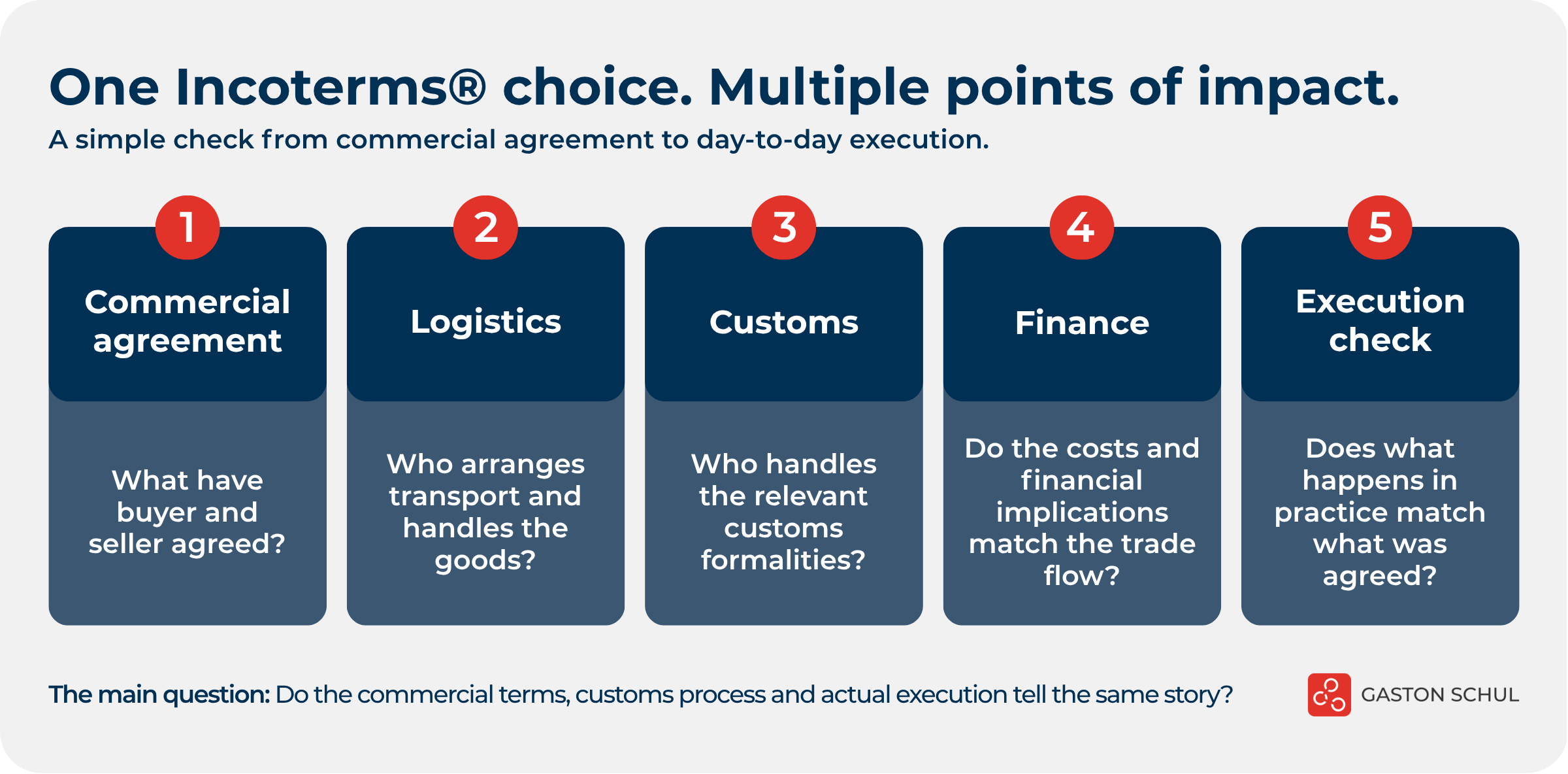
A practical Incoterms® policy should make five things clear:
- Which Incoterms® rules do we normally use, and why?
- Who can agree an exception?
- Who needs to know when that happens?
- Do our commercial terms match our transport and customs processes?
- Does the documentation support what was agreed?
And crucially: would Sales, Logistics, Finance and Customs give the same answer?
That is where knowledge and process come together. Gaston Schul's Customs Academy includes Incoterms 2020 as a bespoke training topic. Training can address knowledge gaps, while standardised procedures can help translate that knowledge into consistent execution.
The objective is not simply for more people to know what FCA, EXW or DDP stands for. It is for the people involved in the transaction to understand what the chosen rule means for what happens next.
From knowing the rules to applying them consistently
The ICC Incoterms® rules give buyers and sellers a common language for international trade. But a common language only works when the people using it share the same understanding.
The evofenedex research suggests that this remains a challenge. Businesses can know Incoterms® well and still experience gaps between the agreement and its execution.
Closing that gap means looking beyond the three letters in the contract. Choose the rule consciously. Make responsibilities clear. Connect the commercial agreement with the actual trade flow. Build that understanding across the departments involved. And periodically check whether what happens in practice still matches what was agreed.
Because understanding Incoterms® is important. Applying them consistently across the business is what makes that understanding useful.