
UK CBAM and EU CBAM: Similar objective, different mechanism.
- donderdag, september 17, 2026
- 5 minuten leestijd

If your business is already dealing with the EU Carbon Border Adjustment Mechanism (EU CBAM), the UK Carbon Border Adjustment Mechanism (UK CBAM) may look reassuringly familiar. The objective is similar, the terminology is familiar and some of the same products and emissions information will be involved. If UK CBAM is completely new to you, the same starting point applies: first understand whether your imports are affected and what the new regime requires.
Experience with EU CBAM gives businesses a useful head start, but it can become a blind spot if we assume the UK regime works in the same way. It does not. For businesses trading into both markets, our EU CBAM muscle memory will help, but it does not transfer cleanly to the UK.
Similar goals, different rules
Perhaps the most important difference is how the two systems work in practice.
EU CBAM operates as a certificate-based mechanism. The UK has chosen a different model: UK CBAM will be a self-assessed tax administered by HMRC. Businesses that meet the requirements will need to register, calculate their liability, submit UK CBAM returns and pay the tax due.
For me, this is the first important mindset shift. UK CBAM is not simply another charge collected as goods cross the border, nor is it the EU certificate model transplanted into the UK. Imports create the exposure, but businesses need to be able to identify that exposure and account for it through a separate tax and reporting process.
For businesses assessing whether UK CBAM applies to them, scope starts with commodity classification. The relevant UK CBAM commodity codes are set out in Schedule 16 to the Finance Act 2026. That fundamental difference in approach is accompanied by several others.
5 of the key differences between EU CBAM and UK CBAM
1. Certificate scheme vs self-assessed tax
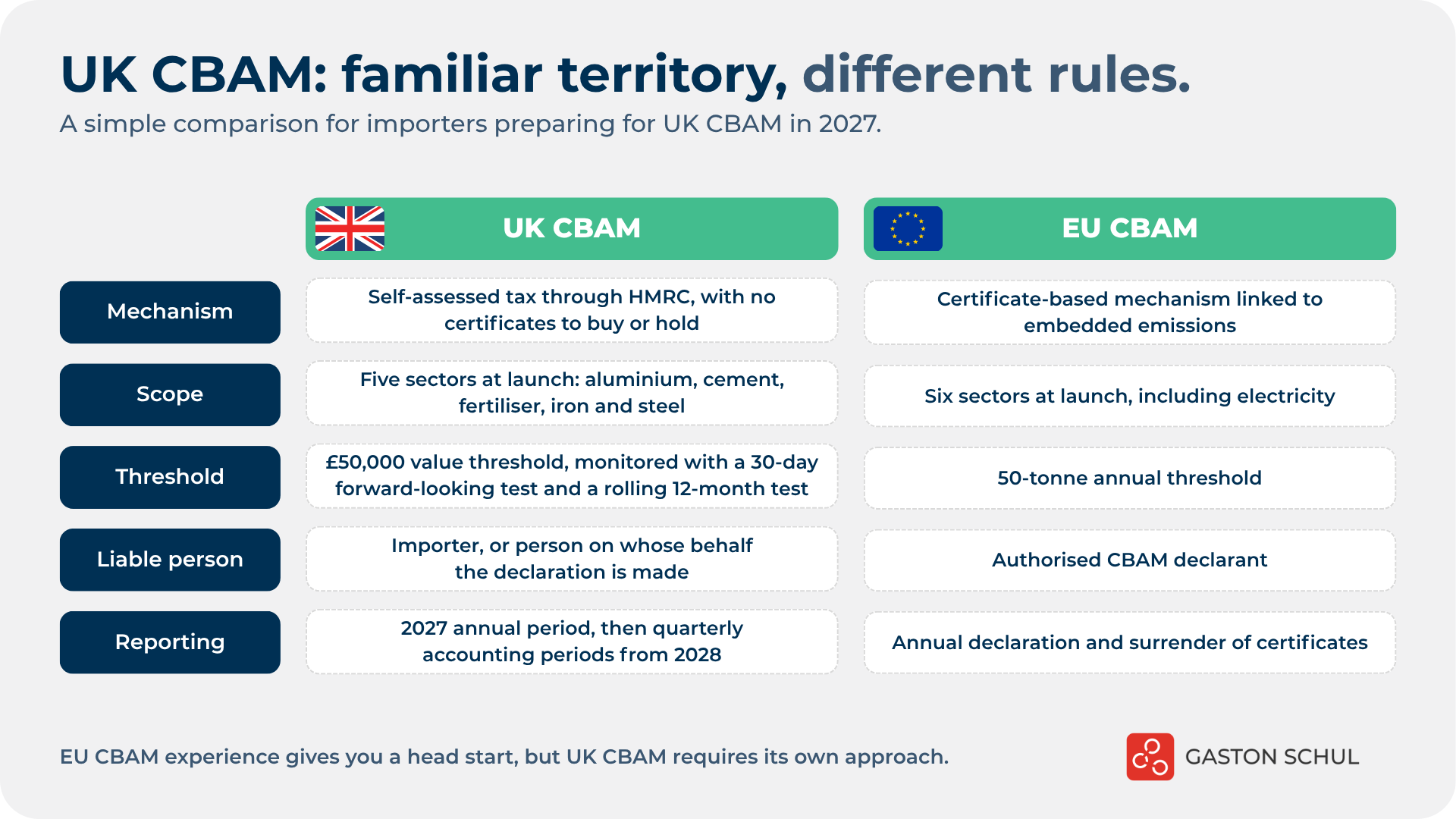
EU CBAM operates through certificates linked to embedded emissions. UK CBAM will operate as a self-assessed tax through HMRC, with no certificates to buy or hold.
2. Six sectors vs five at launch
EU CBAM covers six sectors, including electricity. UK CBAM will initially cover aluminium, cement, fertiliser, hydrogen, iron and steel, with electricity excluded.
3. Different registration thresholds
EU CBAM uses a 50-tonne annual de minimis threshold. UK CBAM instead uses a £50,000 minimum registration threshold based on the value of CBAM goods. Unlike the EU's annual threshold, the UK threshold is monitored on an ongoing basis, looking both at whether you expect to reach £50,000 within the next 30 days and whether you have reached it over the preceding rolling 12-month period.
4. Different liable persons
Under EU CBAM, the obligation sits with the authorised CBAM declarant. Under UK CBAM, the liable person is the importer, or the person on whose behalf the customs declaration is made.
5. Different reporting and payment models
EU CBAM works through an annual declaration and the surrender of certificates. UK CBAM will be accounted for through returns to HMRC. Its first accounting period covers 2027, before moving to quarterly accounting periods from 2028.
Taken individually, some of these may look like technical differences. The comparison below brings the key distinctions together. Taken together, they point to something more important: an EU CBAM process cannot simply be copied across and renamed. Familiar products do not necessarily mean familiar obligations.
One supply chain, two CBAM regimes
This is where I think the comparison becomes particularly relevant for businesses trading across both Britain and the EU.
Consider a company trading steel or aluminium across both markets. It may be dealing with the same product groups, some of the same producers and some of the same underlying emissions information. Depending on the direction of trade, however, that business could be navigating two separate CBAM mechanisms.
There may be opportunities to use common information across both regimes, but UK CBAM has its own monitoring and verification requirements and the compliance processes need to be understood separately. Being prepared for EU CBAM does not automatically mean being prepared for UK CBAM.
There has also been discussion around linking the EU and UK Emissions Trading Systems, which could affect the relationship between the two CBAM regimes in future. It is an important development to watch, but I would not build today’s preparations around an outcome that has not yet been confirmed. For now, businesses need to prepare for the requirements they face while keeping an eye on how the relationship between the two systems develops.
Preparation starts with understanding your exposure
UK CBAM takes effect on 1 January 2027. Imports from that date can create a UK CBAM liability. Although HMRC's registration service will not open until 1 January 2028, businesses must monitor the threshold and retain the required import records throughout 2027. The first accounting period covers the 2027 calendar year, with the first return and payment due by 31 May 2028. From 2028, UK CBAM moves to quarterly accounting periods.
The first return may still seem some way off. In practice, however, several of the decisions and information flows needed to support it need to be addressed much earlier.
For me, this is where the real preparation challenge starts. UK CBAM brings together customs information, supplier emissions data and supporting evidence. Businesses need to know which imports are affected, whether their customs data is reliable, where the emissions information they need will come from and, where actual emissions data is used, whether the required verification will be available.
Some of that information will depend on suppliers and producers, so gaps can take time to resolve. Finding those gaps before UK CBAM begins is one thing. Finding them when you need the information for reporting is quite another.
So at this stage, I think the most useful question is no longer simply: “Do we understand UK CBAM?” It is: “Do we understand our exposure to UK CBAM?”
That shifts the conversation away from the legislation in the abstract and towards what the new regime means for your own imports, supply chain and organisation.
That is why we have created a practical UK CBAM readiness checklist, covering the key checks importers can make now to assess their exposure, prepare their data and identify where further action may be needed.
EU CBAM experience gives businesses a head start. The mistake would be assuming that a head start means the work has already been done.
Explore our CBAM Trade Intelligence
Want to learn more about either regime? Explore our dedicated UK CBAM and EU CBAM Trade Intelligence pages for further guidance and updates.
This article reflects UK CBAM legislation and HMRC guidance available at the date of publication. Requirements may be updated as further guidance and notices are published.